
New findings out now
Today, 5th March 2026, Museum of Homelessness released the second edition of our investigation Severe Weather Emergency 2022-2024, which scrutinises how councils and services are adapting to increasingly extreme weather.
Our investigation has highlighted continued service failings during increasingly extreme weather, but has also identified some changes to policies around climate and homelessness.
This is the only data set of it’s kind in the UK.
This week, co-director Matt Turtle met with the Ministry for Housing, Communities and Local Government, on request, to share our findings.
Co-director Jess Turtle will be giving evidence at the London Assembly Housing Committee on 12th March regarding SWEP and wider homelessness issues.
Seperately, Lord Bird, founder of the Big Issue and cross-bench peer made the following comments
“2023 and 2024 were both in the top ten wettest years of the last two centuries. 14 named storms hit the UK in that time. The fact that so few councils activated SWEP for heavy rain in the period is a blatant failure.
“Sleeping in a storm is no less dangerous than sleeping in a frost. Local authorities clearly need to broaden their criteria and ensure SWEP’s powers are fully comprehensive in protecting rough sleepers.”
Key Findings
· 90% of activations in the 2 years investigated were for cold weather only, highlighting a lack of provision for other forms of extreme weather. Very few councils activated SWEP for extreme rain.
· Gatekeeping is the norm for many councils and services. 42% of responding councils used some kind of verification system as a pre-condition to access SWEP. The use of mental health assessments, risk assessments and triaging procedures is normal.
“SWEP still acts as something of a draw for people who may not be sleeping rough – usually looking for a hotel. Challenge is how to tell who is really rough sleeping and who isn’t.”
London Borough of Hounslow policy document
Use of ‘sit-up’ services
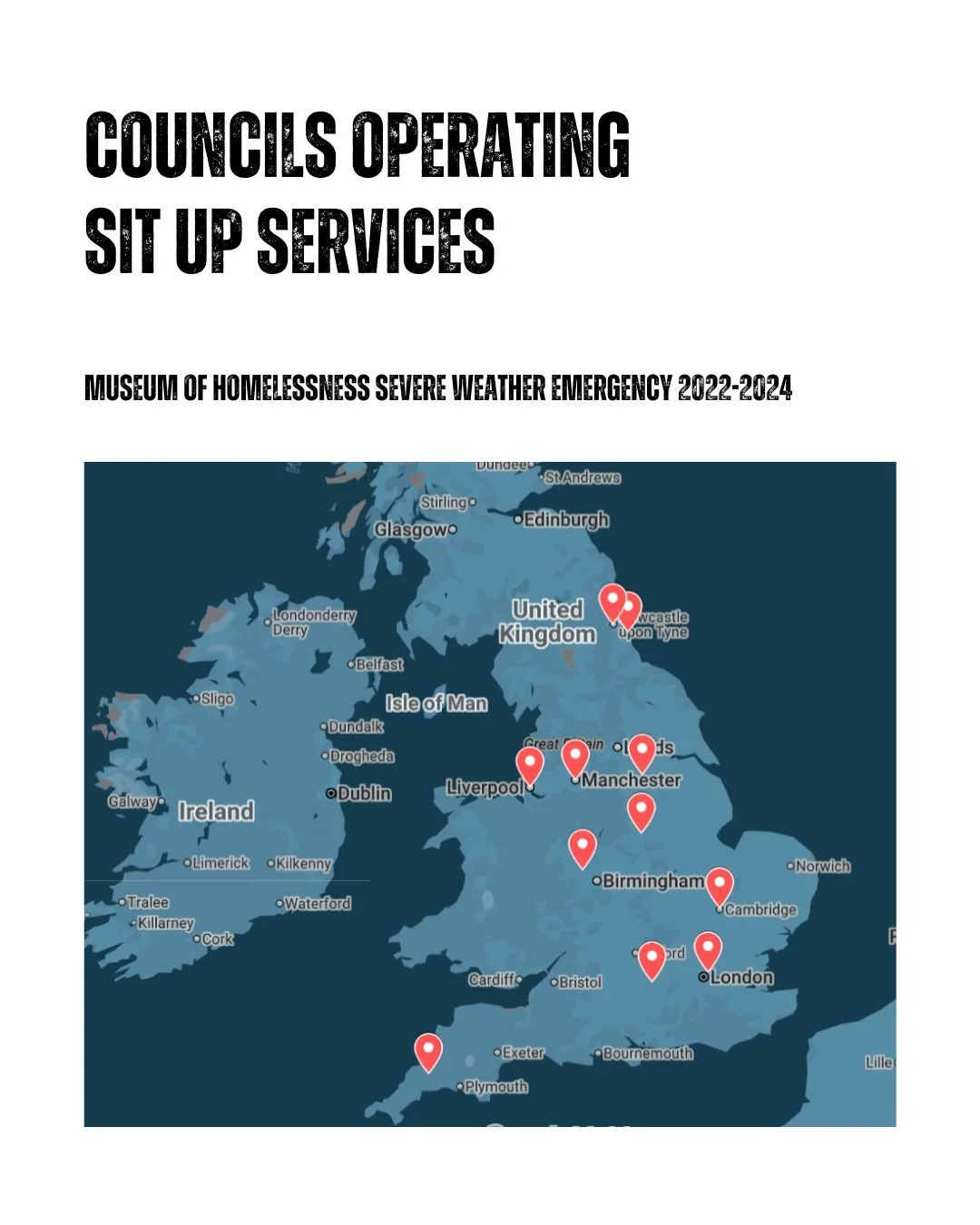
A particular worry is the use of sit-up services – an offer of a chair for sleeping sitting up – widely criticised by homeless people and campaigners. We found 11 councils offering sit-up services in our investigation.
· Councils still do not communicate well about SWEP. Nearly half of all councils involved do not even mention it on their website, indicating bias and stigma towards a public health issue.
· Despite this, councils are more climate aware. 87% of surveyed councils had introduced different measures for extreme weather – a 13% rise on our last investigation.
· On top of this, nearly two thirds of all councils surveyed had created new policies and procedures in relation to extreme weather conditions. However, these have yet to be implemented.
8 reasons someone may not go inside during extreme weather
Services often worry about why people refuse SWEP offers. Working with people who are homeless to gather evidence, we have identified the top 8 reasons why:
Bad quality provision unlikely to provide respite - easier to sleep outside
Too far and no thought given to how people will get back
Not worth it for one night
Too disruptive to routine - including being expected to move in middle of night just for a few hours
Feeling safer on the streets
Concern about losing belongings or sleep sites
Conditionality of offer or overbearing assessments
Lack of trust in services
We are grateful to our partner the Simon Community for helping gather this evidence from the streets for this part of the investigation and helping us ensure the detailed experiences of people who are homeless are represented in our findings.
We have used these findings to create some tools, included in the report, to help services improve their offer and save lives.